It reads you
while you read.watch.
TELA models what you know — every word, every encounter — and shows you only what's just out of reach. Drop any text: a book, an article, a song lyric, a subtitle, a transcript. It becomes your next lesson.
Every word has a state. TELA tracks it for you.
As you read, TELA counts every encounter you have with every word — what context it appeared in, its etymology, how it relates to languages you already know. The state updates as you read; the text colors itself.
You don't curate. You don't mark. The text colors itself.
(You can still tag words manually if you want — TELA just doesn't require it.)
Whatever you'd already want to read.
No curated graded readers. No bite-sized exercises. Bring the texts you'd actually spend an evening with.
The languages you already know are an accelerator.
TELA traces every word through Wiktionary's etymology graph. When a word in your target language has a relative in a language you already know, TELA gives you the head start automatically — no manual research, no drilling. You learn related words by recognition.
The more languages you've touched, the faster the next one comes.
B1 in 125–250 hours of reading.
A conversational vocabulary of ~3,000 words, built by reading material you'd actually want to read in your target language — articles, chapters, lyrics, subtitles. No drills, no flashcards, no scheduled reviews.
A language close to one you already know lands at the low end. A linguistically distant one lands at the high end.
Material you find genuinely interesting takes the least time. Material you tolerate takes more.
A reading habit beats heroics. Twenty minutes a day finishes the book; one Sunday a month doesn't.
The theory TELA is built on.
Stephen Krashen's decades of research argue that language is acquired, not learned — that conscious rules and drills don't make a speaker. Comprehensible input does. TELA is one way to operationalize that.
“Language acquisition does not require extensive use of conscious grammatical rules, and does not require tedious drill.”
“Comprehensible input is the crucial and necessary ingredient for the acquisition of language.”
“Optimal learning happens when the learner is exposed to language slightly beyond their current level — but only as much as it stays comprehensible and isn't overwhelming.”
Someone else got here too — by a different path.
TELA was built without reading Fluent Forever. The colored states, the frontier idea, the rule that meaning comes from real context — they arrived intuitively, from sitting with the problem. When I finally read Gabriel Wyner's revised 2024 edition, the convergence was almost uncanny. We agree on what to expose the learner to. We disagree on the mechanism — and below, I'll argue TELA's mechanism is the better one for most adult readers.
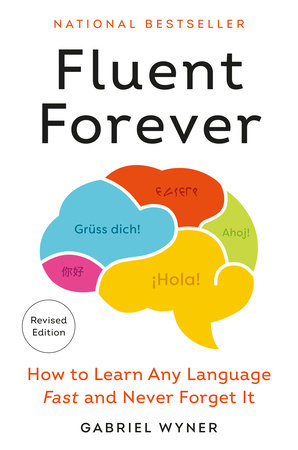
Gabriel Wyner · Harmony, 2024
shown for comparison · not affiliated
- Comprehensible input is the load-bearing mechanism — not drills, not rules.
- Frequency-first — the high-mass words show up before the rare ones.
- No translation laid over the page; meaning is built inside the target language.
- Ambiguity tolerance — words that aren't yet load-bearing for you don't get foregrounded.
- Personal interest drives content choice; the curriculum is what you'd already want to read.
- Wyner reviews words on artificial Anki flashcards. TELA reviews them by re-encountering them in texts you actually want to finish.
- Wyner builds meaning through Google-image associations on cards. TELA builds it through context plus a centroid-disambiguated dictionary on demand.
- Wyner asks you to maintain a deck. TELA asks you to read.
- Frequency is derived from your actual reading, not a static 625-word list. Your domain becomes your curriculum.
- i+1 is a UI affordance — the color system makes the frontier visible instead of asking you to track it.
- No card-deck to build, no daily ritual to fall off. The review schedule is whatever you read next.
- Wyner's revised 2024 edition adds interest-curated vocabulary — that has been TELA's default from day one. The two methods are converging from opposite directions.
- Pronunciation: a dedicated trainer is on the build path as a sibling module — not stitched into the reader. The reading side stays focused on what it does best; the ear-and-mouth phase gets its own surface.
- Active production: AI-powered conversations and a community with live events will carry the production stage, arriving as TELA grows past the alpha.
Get on the list. We'll email when you're in.
TELA is in closed alpha. We'll email you when your seat is ready.